
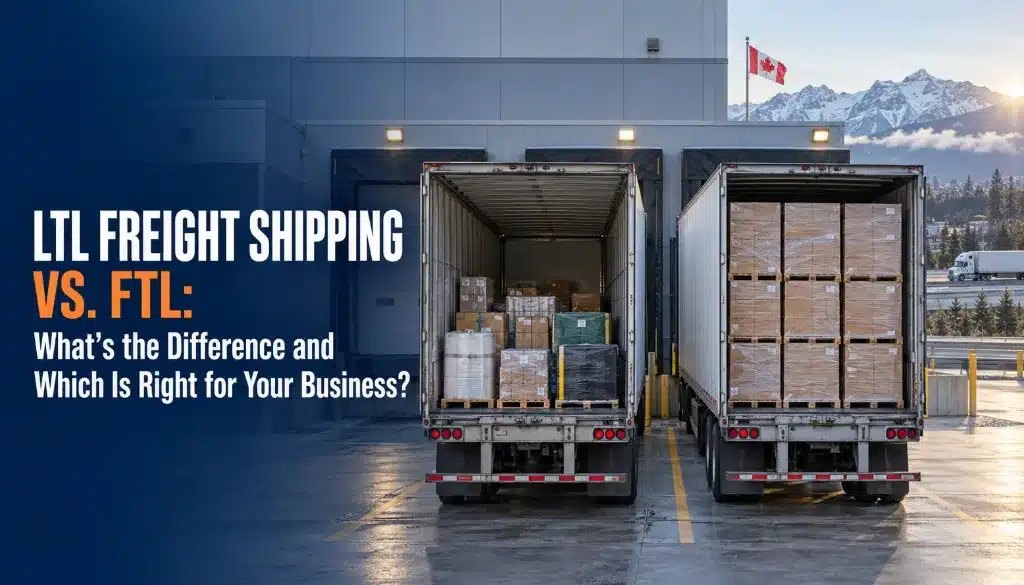
LTL vs. FTL at a Glance
Less-than-truckload (LTL) shipping allows several businesses to share space in the same trailer. Full truckload (FTL) shipping provides one shipper with dedicated trailer capacity.
That basic difference affects freight costs, transit time, handling and available capacity. LTL freight shipping is often suitable when a shipment does not require an entire trailer, while FTL may be more appropriate for larger loads, direct transportation or time-sensitive freight.
However, the right choice depends on more than shipment size. Weight, dimensions, pallet count, urgency, destination and delivery requirements can all influence the decision. Canadian businesses must also consider whether the shipment is moving domestically or crossing the Canada–U.S. border.
Complete Shipping Solutions provides both LTL and FTL services through its carrier network, allowing businesses to compare the options available for each shipment.
What Is LTL Freight Shipping?
LTL stands for “less than truckload.” It describes freight that occupies only part of a trailer rather than requiring the entire vehicle.
With LTL consolidation, a carrier combines shipments from multiple businesses into one truck. Each shipper pays for the portion of capacity used, along with applicable transportation and service charges. Shipments may move through terminals where freight is consolidated, transferred and separated for final delivery.
LTL is commonly used for:
- Palletized products
- Boxed commercial goods
- Parts, supplies and equipment
- Retail inventory
- Smaller recurring business shipments
For small and mid-sized businesses, LTL provides access to freight transportation without paying for dedicated truck capacity that may not be needed. It can offer cost efficiency, flexible pickup and delivery options, shipment tracking and the ability to scale as order volumes increase.
Businesses using LTL shipping in Canada can also move eligible freight across the Canada–U.S. border. Instead of arranging an entire truck, they can compare carriers, service levels and LTL freight shipping rates for their actual shipment.
What Is FTL Freight Shipping?
FTL stands for “full truckload.” In an FTL shipment, the trailer is dedicated to one shipper’s freight rather than being shared with other businesses.
The shipment can usually travel more directly from the pickup location to the destination. Because it does not normally require the same consolidation and deconsolidation process as LTL, FTL generally involves fewer handling points.
FTL may make sense for:
- Larger-volume shipments
- Freight using most or all of a trailer
- Time-sensitive deliveries
- Goods for which minimizing handling is important
- Shipments requiring dedicated capacity
- High-volume commercial freight moving to one destination
The key advantages of FTL shipping include exclusive trailer use, reduced handling and the potential for improved transit times on direct routes.
LTL vs. FTL Freight Shipping: What’s the Difference?
The main difference is how trailer capacity is allocated. LTL shares capacity among multiple shipments, while FTL reserves the trailer for one shipper.
| Factor | LTL Freight Shipping | FTL Freight Shipping |
| Truck space | Shared | Dedicated |
| Shipment size | Smaller loads | Larger loads |
| Cost structure | Pay for the capacity used | Pay for dedicated truck capacity |
| Handling | More potential handling and consolidation | Generally fewer handling points |
| Transit | May involve terminals and multiple stops | Often more direct |
| Flexibility | Well suited to smaller shipments | Suited to larger-volume freight |
| Best for | Businesses shipping partial loads | Businesses shipping large loads |
| Capacity | Shared carrier capacity | Dedicated trailer capacity |
These differences influence cost, speed and handling, but they do not make one method universally better. The correct option is the one that fits the shipment and its delivery priorities.
LTL vs. FTL: Which Freight Option Costs Less?
LTL is often less expensive for smaller loads because businesses share transportation costs. However, there is no universal answer to the LTL vs. FTL cost question.
As a shipment becomes larger or occupies more trailer space, the difference between LTL and FTL pricing may narrow. In some cases, an FTL quote may provide better overall value, particularly when direct transportation, reduced handling or faster delivery is important.
LTL freight shipping rates can be influenced by:
- Total shipment weight
- Dimensions and pallet count
- Commodity and applicable freight classification
- Origin, destination and distance
- Fuel surcharges
- Carrier capacity
- Packaging
- Residential or limited-access locations
- Appointment, inside delivery or power tailgate service
- Declared value or additional insurance requirements
- Other accessorial charges
For cross-border freight, documentation and border-related requirements can also affect the shipping process. The most reliable approach is to request comparable quotes using complete and accurate shipment information.
When Should You Choose LTL Freight Shipping?
LTL may make sense when:
- You have a few pallets rather than a full trailer
- Your freight does not justify dedicated truck capacity
- You want to consolidate smaller shipments
- You require flexible pickup or delivery options
- You ship regularly in smaller quantities
- You want a scalable option as freight volume grows
For example, a Canadian manufacturer shipping three to six pallets from Edmonton to Toronto may not need an entire trailer. LTL would be worth comparing with FTL based on the shipment’s dimensions, weight, commodity, delivery timeline and special-service requirements.
Pallet count should be treated as a practical indicator rather than a fixed rule. A small number of oversized, heavy or unusually shaped pallets may use more trailer capacity than expected.
When Should You Choose FTL Freight Shipping?
FTL may be more appropriate when a shipment uses most or all of a trailer, requires dedicated capacity or needs to reach its destination through a more direct route.
It is particularly useful for:
- Large-volume commercial shipments
- Multiple pallets moving to one destination
- Time-sensitive freight
- Goods that benefit from fewer handling points
- Shipments with specific capacity requirements
- Freight where direct origin-to-destination transportation is preferred
Complete Shipping Solutions currently recommends considering FTL for shipments over 10,000 lb or containing 10 or more pallets. However, these figures should be treated as service guidelines rather than universal thresholds. Pallet dimensions, density, route, equipment and current rates can all change which mode is more practical.
How Canadian Businesses Can Choose Between LTL and FTL
Use the following questions to compare your options:
1. What are you shipping?
Record the commodity, total weight, dimensions, packaging and handling needs. Accurate information helps carriers quote the shipment correctly.
2. How much freight do you have?
Consider pallet count and total trailer space, not weight alone. Large or non-stackable pallets can use substantial capacity.
3. How quickly does it need to arrive?
LTL may be suitable for standard delivery timelines. Time-sensitive freight may benefit from FTL or another expedited service.
4. Where is it going?
Confirm whether the destination is within Canada or across the Canada–U.S. border. Cross-border shipments require accurate documentation and coordination.
5. Does the shipment need special services?
Identify residential delivery, inside delivery, appointments, power tailgate service, limited-access delivery or special equipment before requesting a quote. These services may carry additional charges.
6. What does the actual quote show?
Compare the total transportation cost, estimated transit time, service level and included charges. Do not assume LTL or FTL is less expensive based only on pallet count.
How to Reduce LTL Freight Shipping Costs
Businesses can control LTL costs by improving shipment accuracy and avoiding preventable charges.
- Compare multiple carrier rates: Pricing and service levels can vary by route, shipment and available capacity.
- Provide accurate measurements: Incorrect weight or dimensions may result in reclassification or additional charges.
- Package freight properly: Secure products to suitable pallets and use appropriate wrapping, straps and corner protection.
- Identify accessorial services early: Select appointments, residential delivery, inside delivery or power tailgate service during booking.
- Prepare accurate documents: Check addresses, commodity details, shipment quantities and the bill of lading.
- Consolidate when practical: Combining compatible shipments can reduce repeated pickup and handling costs.
- Choose only the services required: Match delivery options to the actual receiving location.
- Use shipping technology: A centralized platform can make rate comparison, booking and documentation more efficient.
- Review tracking data: Recurring delays or route issues may indicate that another carrier or service level should be considered.
SMARTT Shipping provides real-time freight quotes from multiple carriers and supports booking, document generation, pickup scheduling, tracking and shipment management.
LTL Freight Shipping With Complete Shipping Solutions
When comparing LTL freight shipping companies in Canada, businesses should look beyond the lowest displayed rate. Carrier coverage, service options, technology, tracking and support can be equally important.
Complete Shipping Solutions offers LTL freight shipping across Canada and cross-border shipping between Canada and the U.S.. Through SMARTT Shipping, customers can compare rates and transit times from a network of more than 200 carrier and courier partners.
The platform also supports shipment booking, bills of lading, labels, pickup scheduling and centralized tracking. Customer Care and Claims teams are available to assist with tracking, special requests, invoice questions and freight claims.
If LTL is not the right fit, businesses can also explore FTL, domestic, cross-border, international and specialty freight services.
Conclusion: Choose the Freight Method That Fits Your Shipment
LTL is designed for freight that does not require an entire truck, allowing businesses to share trailer capacity. FTL provides dedicated capacity and is often better suited to larger, more time-sensitive or handling-sensitive shipments.
The best option depends on shipment size, cost, transit expectations, handling needs, route and delivery requirements. Canadian businesses should compare actual LTL and FTL quotes for each shipment instead of relying on one fixed rule.
Need help deciding between LTL and FTL?
FAQs
What is the difference between LTL and FTL freight shipping?
LTL combines freight from multiple businesses in one trailer. FTL dedicates the trailer to one shipper. LTL usually involves more consolidation and handling, while FTL often follows a more direct route.
Is LTL freight shipping cheaper than FTL?
LTL is often more economical for smaller shipments because the cost of trailer capacity is shared. For larger loads, the price difference may narrow, so businesses should compare complete quotes.
How many pallets can you ship with LTL freight?
There is no universal pallet limit. The suitable mode depends on pallet dimensions, weight, stackability, trailer space, carrier rules and route. Request both LTL and FTL pricing when a shipment begins using substantial capacity.
When should a business choose FTL instead of LTL?
Consider FTL when freight uses most or all of a trailer, requires dedicated capacity, is time-sensitive or would benefit from fewer handling points and more direct transportation.
Can I use LTL freight shipping for cross-border shipments between Canada and the U.S.?
Yes. LTL can be used for eligible freight moving in either direction across the Canada–U.S. border. Accurate shipment and customs documentation is essential for avoiding preventable delays.