
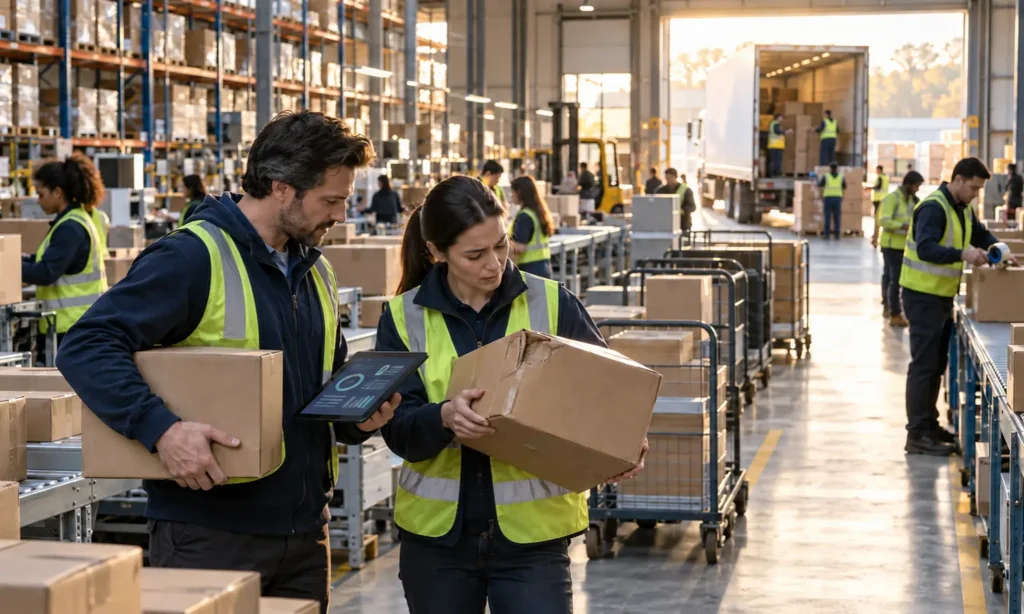
A package misses its delivery window. Another arrives damaged. Then a promotion generates twice the orders your team expected. Even a well-run warehouse will face exceptions like these. The question is what happens when logistics don’t go according to plan?
For a growing business, storage alone cannot solve a carrier delay, locate a missing parcel or clear a backlog of orders. Responsive warehouse logistics services connect inventory records, fulfilment work, shipping options and customer communication. That connection helps a team spot a problem, identify who needs to act and keep orders moving where possible.
What Are Warehouse Logistics Services and Why Do They Matter?
Warehouse logistics services manage the flow of goods into, through and out of a warehouse. In a Canadian business, that can include receiving and inventory management, order processing, pick and pack, freight shipping, e-commerce fulfilment and returns. For companies selling across the border, the work also connects to Canada–U.S. shipping.
Renting warehouse space gives a business somewhere to keep products. An integrated logistics partner also helps turn available inventory into correctly prepared orders and coordinates their delivery. If an item is placed on hold, for example, the inventory record should prevent it from being picked for a new order. If a customer returns an item, the team needs a process to inspect it before deciding whether it can be sold again.
Outsourcing through 3PL warehouse services in Canada often makes sense when order volume is rising, the business is adding sales channels or an in-house team spends too much time coordinating warehouses and carriers. The benefit depends on the provider’s processes: better coordination can reduce avoidable errors and give customers more reliable information about their orders.
How Do Warehouse Logistics Services Handle Shipping Delays?
Delays can begin at several points: a carrier disruption, severe weather, congestion at a border, an incorrect address, a missed warehouse processing step or limited transportation capacity. The first task is to establish where the shipment is and why it stopped moving.
A logistics team can compare the order record, warehouse dispatch time and carrier tracking events. If the parcel has not left the warehouse, it can investigate the processing issue. If the carrier has it, the team can request an update and determine whether an intervention is possible. The customer should receive a clear status and a realistic next update, especially when a promised delivery date is at risk.
Alternative services may help with orders that have not yet shipped. Once a package is in transit, options depend on its location and the carrier’s rules. To reduce repeat delays, businesses should review address errors, order cut-off times, carrier performance and how early they send demand forecasts to their provider.
When choosing a provider, ask how it flags stalled shipments, who contacts the carrier, who updates customers and what happens when the original delivery plan cannot be met. These details matter more than a general promise of fast shipping.
What Happens When a Package Is Lost or Damaged?
A missing tracking update does not automatically mean a package is lost. A structured response starts by checking the shipment’s tracking history and delivery details, then asking the carrier to investigate. For damage, the customer or receiving team should preserve the packaging and record photographs of the item, carton and shipping label.
The typical exception process is:
- Confirm the facts: Match the order, tracking number, contents and latest carrier event.
- Contact the carrier: Open an investigation or report the damage under its process.
- Keep the evidence: Collect photos, proof of value and other documents required for a claim.
- Reconcile inventory: Determine whether the item was dispatched, returned or written off.
- Resolve the customer order: Arrange a replacement, reshipment or other remedy where appropriate.
Claim eligibility, deadlines and compensation depend on the carrier’s terms and the shipment’s coverage. An experienced logistics partner gives the business a consistent way to gather evidence, coordinate follow-up and avoid losing track of the customer’s order while a claim is reviewed.
Prevention matters too. Suitable packaging, accurate pick and pack checks, handling instructions and a carrier service suited to the product can reduce avoidable damage.
How Can Logistics Providers Handle Sudden Volume Spikes?
Holiday shopping, promotions, product launches, seasonal demand and a viral product can all create more orders than forecast. The same can happen when online sales grow unexpectedly across several channels.
A scalable operation plans for space, people, inventory and transport together. The business can share campaign dates and expected order volumes early. Its provider can then discuss storage needs, staffing and fulfilment workflows, while checking carrier capacity before the surge begins. Batch picking may help when many orders contain the same product; order prioritisation can protect commitments with earlier cut-off or delivery dates.
Technology provides a view of incoming orders and available stock, but forecasts still need regular updates. After a spike, comparing expected and actual volumes helps both parties prepare for the next one.
When assessing warehouse and fulfillment services in Canada, ask how the provider adjusts capacity and processes as demand changes. A fixed warehouse model may become restrictive as a business grows.
How Technology Helps Manage Warehouse and Shipping Exceptions
Warehouse and shipping systems are most useful when they connect an order to its inventory, fulfilment and tracking records. A warehouse management system can show available stock, holds and order activity. Carrier integrations can bring shipment events into a central view, while automated updates pass tracking information to the business or customer.
How can technology prevent shipping delays? It cannot prevent weather or carrier disruption. It can help catch incomplete order information before dispatch, reveal a fulfilment backlog and flag a shipment that has not progressed as expected.
How does automated shipment tracking work? The carrier records events such as pickup and delivery; an integration shares available events with the shipping platform or connected store. Tracking visibility can vary by carrier and shipping stage.
To improve logistics visibility, look beyond a tracking page. Review order age, inventory accuracy, fulfilment times, delayed shipments and recurring exception reasons. Those reports can reduce manual status requests and show where a process needs attention.
Managing Cross-Border Shipping Exceptions Between Canada and the U.S.
Cross-border orders involve more than a longer route. They may pass between carriers or transportation stages and require customs information before the goods can be released. Missing or inconsistent product descriptions, values, addresses or shipment documents can interrupt that process. Businesses also need to establish who is responsible for applicable duties and taxes.
For commercial goods entering Canada, the Canada Border Services Agency explains that carriers report shipment information and that importers or their brokers provide the documents needed for release. It notes that goods reported incorrectly may face border-processing delays. Requirements differ by shipment and direction, so businesses should confirm the documentation and importer responsibilities for their specific goods.
A 3PL partner can coordinate warehouse release, carrier handoffs and shipment tracking while helping the business identify a documentation problem early. Canadian companies regularly shipping into the U.S. may find that integration particularly useful. They should still establish who will handle customs brokerage and import requirements; a logistics provider does not necessarily perform those functions itself.
What Should You Look for in Warehouse Logistics Services?
Use this checklist when comparing providers:
- Warehouse capacity that can support planned growth and seasonal demand
- Inventory visibility, including stock levels and order status
- E-commerce fulfilment and suitable pick and pack processes
- Parcel and freight shipping options
- Carrier integrations and accessible shipment tracking
- A defined process for delays, loss, damage and claims
- Returns inspection and handling
- Canada–U.S. shipping coordination
- Reporting on inventory, orders and exceptions
- Responsive support with clear points of contact
- The ability to serve your required destinations in Canada and the U.S.
Questions to ask before choosing a provider
Ask for a walkthrough of a real workflow: How does an order reach the warehouse? When is inventory updated? What happens if a package has no new tracking event? Who contacts the carrier and the customer? How are returns assessed? For a promotion or seasonal peak, how far in advance does the provider need your forecast?
The answers should show how the provider handles routine orders and the days that do not follow the routine.
How Complete Shipping Solutions Helps Businesses Manage Logistics Exceptions
Complete Shipping Solutions offers warehousing in Edmonton alongside order fulfilment, inventory management, parcel and freight shipping, and Canada–U.S. cross-border services. Its published fulfilment process connects an e-commerce store to its warehouse management system, where orders move to picking, packing and shipping. The company also describes inventory tracking and reporting, shipment tracking, and customer care support.
Its SMARTT Shipping platform supports shipping tasks across carrier options, while its cross-border service describes tracking through partner integrations where available and assistance from customer care when an integration is unavailable. These connected services give businesses a way to coordinate inventory, fulfilment and freight when an exception arises.
Conclusion
Logistics exceptions cannot always be eliminated. The practical goal is to identify them promptly, give customers accurate information and resolve them through a clear process. That requires visibility into both the warehouse and the shipment, not separate systems and conversations that leave teams piecing together what happened.
The right warehouse logistics services for Canadian businesses should also be flexible enough to support growth. Whether demand rises steadily or peaks during a promotion, coordinated warehousing, fulfilment and shipping make it easier to respond while keeping inventory and orders in view.
Looking for warehouse logistics services in Canada that can scale with your business?
FAQs
What are warehouse logistics services?
Warehouse logistics services manage how products are received, stored, tracked, picked, packed and shipped. They may also include returns, inventory reporting and coordination with parcel or freight carriers.
How do warehouse logistics companies handle shipping delays?
They check warehouse records and carrier tracking to find where the delay occurred, then contact the responsible team or carrier for an update. They can inform the customer of the revised status and review recurring delays to improve future shipping plans.
What happens if a package is lost or damaged during shipping?
The logistics team investigates the tracking history, contacts the carrier and gathers evidence such as photos, order details and proof of value. The business can then decide whether to replace or refund the order, while any carrier claim proceeds under the applicable terms.
Can warehouse logistics services handle sudden increases in order volume?
A provider with flexible space, staffing and fulfilment processes can prepare for seasonal peaks, promotions and product launches. Sharing forecasts early gives the provider time to plan inventory placement, order priorities and carrier capacity.
How can a 3PL provider help with Canada–U.S. shipping and fulfilment?
A 3PL can coordinate order preparation, carrier selection, shipment tracking and handoffs between transportation stages. The business should also confirm who is responsible for customs documents, brokerage, duties and taxes before shipping.